Stop working — without wondering if the numbers work
Enough income. Affordable health coverage. Fewer tax surprises.And confidence that your money will last.
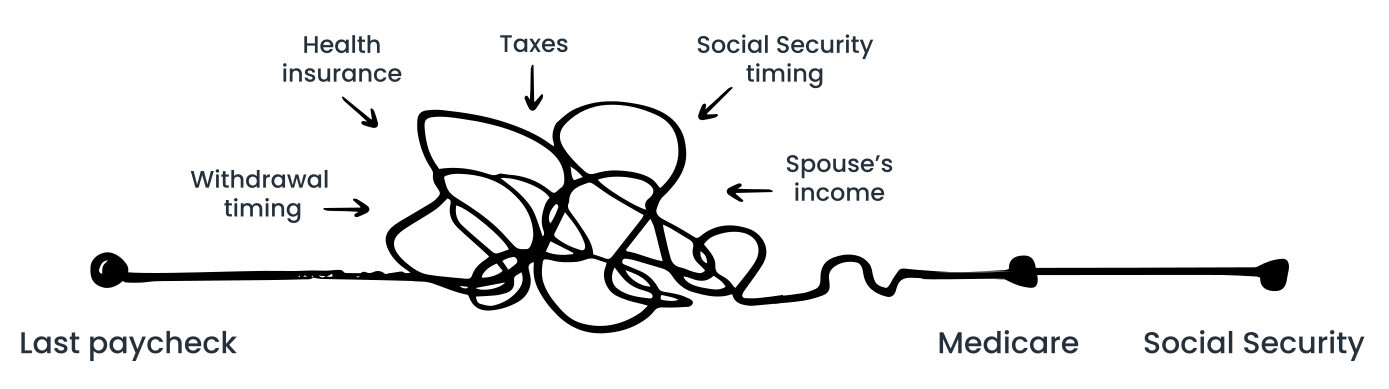
Where are you right now?
I’m thinking about leaving work
Can I really turn off the paychecks and make the numbers work?
- Health Insurance
- Income
- Taxes
- Social Security
My job is ending soon
What do I need to do right now — and what should wait?
- COBRA vs. ACA
- Severance
- Deadlines
- 401k Decisions
I’ve already stopped working
How long will my money last — and can I afford to stay retired?
- Monthly Income
- Health Costs
- Withdrawals
- Social Security
I’m about to make a big financial decision
What else could this decision change?
- 401k Rollover
- Early Access
- Taxes
- Social Security
The questions people actually ask
- Coming soon
Video
I’m 60 and COBRA costs $1,600 a month. Should I look at ACA instead?
- Coming soon
Video
I lost my job at 62. Should I start Social Security now or wait?
- Coming soon
Video
Can I retire at 59 with $1.2 million?
- Coming soon
Video
Should I move my old 401k into an IRA?

The challenge isn’t makingthe right decision.It’s making a series of gooddecisions in the right order.
The Last Paycheck Plan
Build the plan that gets you from your last paycheck to Medicare and Social Security.
A workable income plan. Affordable health coverage. Fewer tax surprises. And your best options still open.
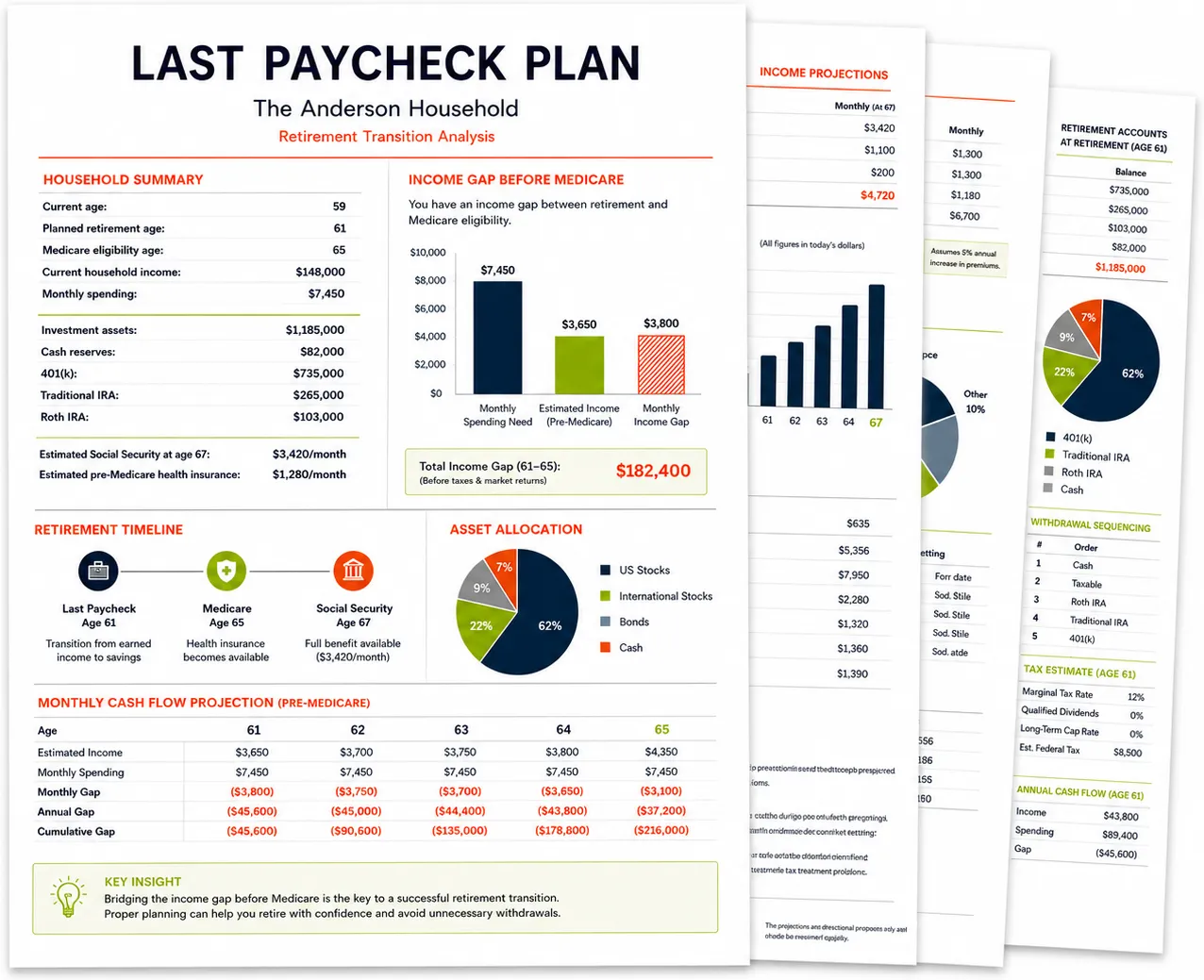
What the plan covers
- Replace the paycheck with a workable income plan
- Find affordable health coverage to Medicare
- Make your savings last
- Draw from the right accounts at the right time
- Time Social Security carefully
- Avoid unnecessary tax surprises
I have no words to describe how helpful this was. Well thought out, easy to understand, and can implement immediately.
What to expect
Step 1
See if it fits
Answer a few short questions. If it looks like we can help, you can book a 20-minute conversation.
Step 2
Build the plan
We’ll gather the numbers, compare your options, and map out the decisions that matter most.
Step 3
See the path forward
See how your income, savings, healthcare, taxes, and timing work together — with a written plan to guide you.
Start with a few questionsNo upfront planning fee. Estimates are enough to start.
Frequently asked questions
What exactly is the Last Paycheck Plan?
It’s a written plan for the gap between your last paycheck and Medicare and Social Security — when several important financial decisions often collide at once.
We look at how you’ll replace the paycheck, pay for health coverage, draw from your savings, and decide when to start Social Security. You leave knowing what to do now, what can wait, and which options to keep open — with a plan for income, health coverage, and the years ahead.
What will I walk away with?
A written plan for getting from your last paycheck to Medicare and Social Security.
Your plan will help you:
- Replace the paycheck with a workable income plan
- Find affordable health coverage to Medicare
- Make your savings last
- Draw from the right accounts at the right time
- Time Social Security carefully
- Avoid unnecessary tax surprises
The goal is simple: health coverage in place, a workable income plan, fewer tax surprises, and your best options still open.
What does the Last Paycheck Plan cost?
There’s no charge for the Last Paycheck Plan.
It’s designed to help you understand where you stand today and what decisions need attention before you make any financial decisions.
Think of it like having your house assessed before you decide on renovations. First, you get a clear picture of what needs attention and what the project actually involves. Then you decide what kind of help, if any, makes sense — and whether you want us to provide it.
How do you get paid?
We don’t charge an upfront planning fee, or a recurring annual planning fee. There’s no cost to sit down with us and build a plan.
If you choose to open an investment account, purchase an insurance product, or have us manage investments for you, we may be compensated. Certain investment and insurance products pay us a commission, while ongoing investment management is compensated through an asset-based advisory fee.
You’re never required to implement anything through us. Before you make a decision, we’ll explain if there are any costs involved, how we’re compensated, and whether there are ongoing fees so you know exactly how the arrangement works.
Do I have to become a client afterward?
No. Some people may have what they need to move forward on their own. Others may want help implementing parts of the plan or ongoing guidance as decisions come up.
Either way, you’ll know what the next step is before you decide whether to take it.

Let’s make the numbers work for your household.
Tell us what’s changed and what you’re trying to figure out.Answer a few short questions.
Get started